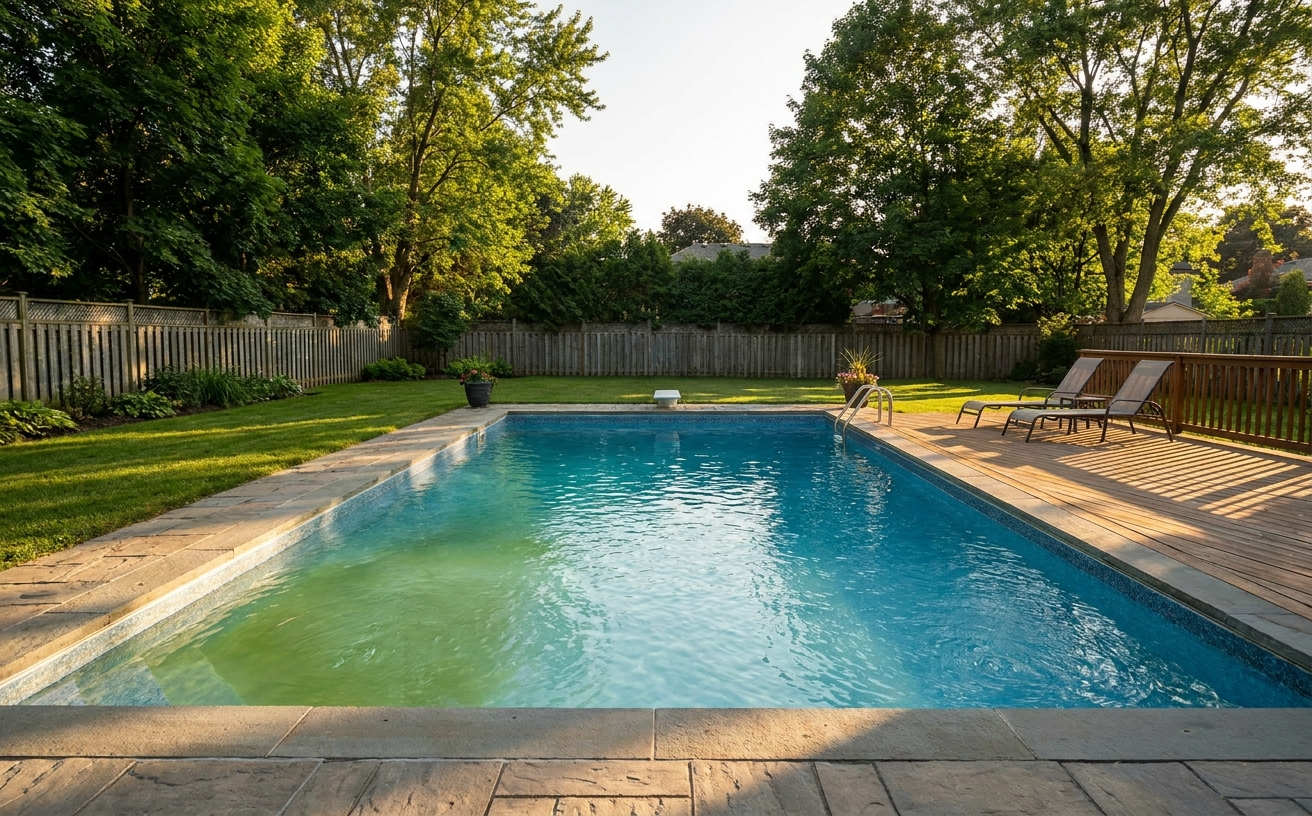

You wake up on a Saturday morning, look at the pool, and the water has a green tint that was not there on Friday. It feels sudden, but it is not. Algae spores are microscopic. They enter the pool constantly through wind, rain, and swimmers. When conditions allow, they begin reproducing. A single spore becomes two, then four, then thousands. The green tint you see on Saturday is the point where the colony has grown large enough to be visible, which means it has been multiplying for one to three weeks.
Understanding the lifecycle of algae and the conditions that trigger its growth is the difference between preventing it entirely and fighting it repeatedly.


The Three Types of Pool Algae
Green algae is the most common and the fastest growing. It floats freely in the water, turns it cloudy green, and can cover the pool floor and walls in a slimy layer within days of the first visible sign. Green algae thrives in warm water with low chlorine and high pH.
Mustard algae appears as yellowish patches on pool walls and floors, typically in shaded areas. It is often mistaken for pollen or dirt because it brushes off easily but returns quickly. Mustard algae is more resistant to chlorine than green algae and requires higher shock doses to eliminate.
Black algae is the most stubborn. It forms dark spots on pool surfaces and sends roots deep into plaster pores and grout lines. Brushing removes the visible portion, but the roots remain and regenerate the colony within days. Eliminating black algae requires aggressive brushing combined with sustained high chlorine levels and sometimes algaecide specifically formulated for black algae.
The Conditions Algae Needs
Algae requires three things: sunlight, warm water, and insufficient sanitizer. Remove any one of these and algae cannot establish. This is why pools rarely develop algae in winter when water temperatures are below sixty degrees, and why indoor pools with consistent chlorine levels almost never have algae problems.
The risk period is late spring through early fall, when water temperatures climb above seventy degrees and sunlight hours are longest. During this period, chlorine demand increases significantly because both algae growth and organic contaminant decomposition accelerate in warm water.
High pH compounds the problem by reducing chlorine effectiveness. A pool at pH 8.0 with three ppm free chlorine has less active chlorine than a pool at pH 7.4 with one ppm. The test shows more chlorine, but less of it is available to fight algae.
Why Algae Returns After Treatment
The most common reason algae returns is incomplete killing. The shock treatment kills the free-floating algae and clears the water, but algae hiding in crevices, behind light fixtures, inside ladder rungs, and in the filter media survives and repopulates the pool within days.
Brushing is essential during shock treatment because it dislodges algae from surfaces where chlorine concentration may be lower than in the open water. Without brushing, the shock kills the easy targets and leaves the protected colonies intact to restart the infestation.
Another reason for recurrence is failing to address the underlying conditions that allowed algae to grow in the first place. If pH was high when the algae appeared and remains high after treatment, the same conditions exist and the same result will follow.
The Shock Protocol
Shocking the pool means raising free chlorine to a level that kills algae and destroys organic contaminants that regular chlorine levels cannot handle. For green algae, the shock level is typically ten to twenty ppm free chlorine. For mustard algae, it may need to reach thirty ppm. For black algae, sustained high levels combined with aggressive brushing are required.
Add the shock in the evening when the sun is off the pool. Sunlight destroys chlorine, and shocking during the day wastes a significant portion of the dose before it can work. Run the pump continuously for at least twenty-four hours after shocking to ensure the chlorine reaches every part of the pool.
Brush all surfaces before and after shocking. Before, to dislodge algae from crevices. After, to remove dead algae from surfaces so the filter can capture it. This dual brushing approach is what separates effective shock treatment from a temporary improvement that reverses within a week.
Algaecide: When and Why
Algaecide is a supplementary treatment, not a replacement for chlorine. It works by disrupting algae cell walls and preventing reproduction, but it does not kill established colonies as quickly or as completely as high chlorine levels. The primary value of algaecide is prevention, not treatment.
Adding a maintenance dose of algaecide weekly during the algae season provides a second line of defense that catches any spores that survive the chlorine barrier. This is particularly useful in pools that have a history of recurrent algae problems or that are exposed to heavy environmental contamination from trees, wind, and rain. A complete pool algae guide typically recommends this dual approach: chlorine as the primary sanitizer and algaecide as the secondary preventive.
Copper-based algaecides are effective against all three algae types but can cause staining if overused. Quaternary ammonium algaecides are less effective against black algae but do not stain. Choose the algaecide type based on the algae you are most likely to encounter and use it at the preventive dose rather than the treatment dose.
The Prevention Mindset
Preventing algae is dramatically easier and cheaper than treating it. A consistent maintenance routine that keeps chlorine in range, pH in range, and the filter running adequately creates conditions where algae cannot establish.
Test twice a week during the swimming season. Add chlorine promptly when levels drop. Adjust pH before it drifts above 7.8. Run the filter long enough to turn over the entire pool volume at least once per day. Brush the walls and floor weekly, paying attention to corners, steps, and behind ladders where circulation is weakest.
These prevention steps form the core of any effective algae management strategy, because they address the conditions that allow algae to establish rather than the symptoms that appear after it has taken hold.
After heavy rain, after pool parties, and after any event that might have introduced contaminants or diluted the chlorine, test immediately and adjust. These are the moments when algae gets its foothold. A timely chlorine addition after a storm costs almost nothing. An algae treatment a week later costs time, chemicals, and swimming days.